
Semaglutide vs Tirzepatide: Understanding Your Weight Loss Options
Both semaglutide and tirzepatide are used in medically supervised weight loss programs—but they work differently. Understanding those differences can help you and your provider choose the most appropriate path.
Licensed Medical Providers | HIPAA-Compliant Virtual Care | Personalized Treatment Plans | Serving GA, FL & AL
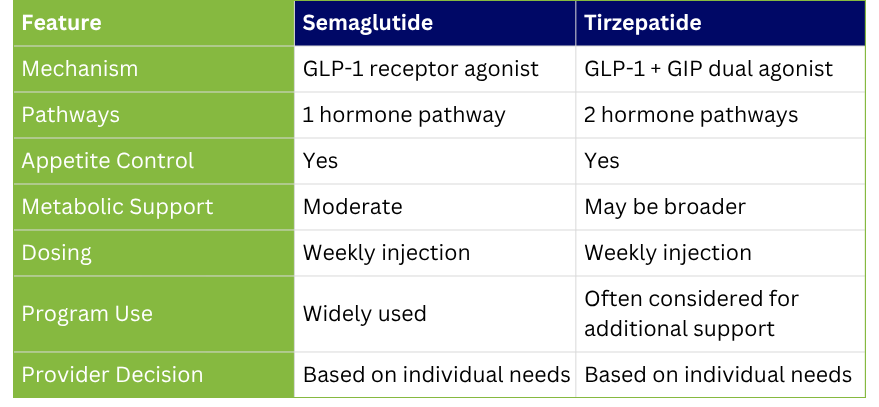
At-a-Glance Comparison
WHAT THESE MEDICATIONS HAVE IN COMMON
Shared Benefits
Both semaglutide and tirzepatide are used in medically supervised weight loss programs and may:
-
- Help regulate appetite
- Increase feelings of fullness
- Support portion control
- Encourage more consistent eating habits
- Be administered as once-weekly injections
Both are most effective when combined with:
-
- Nutrition guidance
- Lifestyle support
- Ongoing provider monitoring

Learn About GLP-1 Programs
KEY DIFFERENCE: HOW THEY WORK
Single vs Dual Pathway Approach
Semaglutide
Semaglutide works by targeting the GLP-1 receptor, helping regulate appetite and digestion.
Tirzepatide
Tirzepatide targets both:
- GLP-1 receptors (appetite + fullness)
- GIP receptors (additional metabolic signaling)
This dual-action mechanism may offer a broader approach to metabolic support for some individuals.
WHAT THIS MEANS IN REAL LIFE
Practical Differences for Patients
While both medications may support weight loss, the experience can vary:
- Some individuals respond well to semaglutide alone
- Others may benefit from tirzepatide’s dual-action approach
- Response, tolerance, and goals all play a role
This is why provider guidance is essential—there is no one-size-fits-all answer.
WHICH ONE IS RIGHT FOR YOU?
Personalized, Not Preset
Choosing between semaglutide and tirzepatide depends on:
- Your medical history
- Your weight loss goals
- Your response to treatment
- Tolerance to medication
At Thrive Telemedicine, your provider will:
- Evaluate your full health profile
- Recommend an appropriate starting point
- Adjust your plan over time if needed
CAN YOU SWITCH BETWEEN THEM?
Flexibility in Your Plan
In some cases, providers may recommend switching medications if:
- Results are not progressing as expected
- Side effects are difficult to manage
- A different approach may better support your goals
Treatment is not static—it evolves with you.
SAFETY & SIDE EFFECTS
What to Expect
Both medications have similar potential side effects, including:
- Nausea
- Digestive discomfort
- Appetite changes
These are often:
- More noticeable early in treatment
- Managed through gradual dosing
- Monitored closely by your provider
COST & ACCESS CONSIDERATIONS
Practical Factors
Costs and access may vary depending on:
- Insurance coverage
- Availability
- Formulation (brand vs compounded when appropriate)
Your provider and care team can help guide you through available options.
Get a Personalized Recommendation
The best way to determine which option may be right for you is through a consultation with a licensed provider.
Frequently Asked Questions
What is the main difference between semaglutide and tirzepatide?
Semaglutide targets GLP-1 receptors, while tirzepatide targets both GLP-1 and GIP receptors, offering a dual-action approach.
Which medication is better for weight loss?
Effectiveness varies by individual. A provider will recommend the most appropriate option based on your health profile and goals.
Is tirzepatide stronger than semaglutide?
Not necessarily “stronger,” but it works through two pathways, which may provide additional support for some individuals.
Can I switch between semaglutide and tirzepatide?
Yes, in some cases providers may adjust medications based on your response and tolerance.
Are side effects the same?
They are similar, though individual experiences may vary.
Do both medications require injections?
Yes, both are typically administered as once-weekly injections.
How do I know which one is right for me?
A licensed provider will evaluate your health history, goals, and response to determine the best option.
Can I start with one and change later?
Yes, treatment plans can be adjusted as your needs evolve.